Hand big work to a swarm.
Mini-bosses drive big work through phase gates until it is actually done.
- Scope big work only
- Bosses per-boss child cap
- Gates phase by phase
- View Lilly Pod
- Describe the goal — state what done looks like, not each command.
- Bosses fan out — capped child agents each take a slice.
- Self-correction runs — stalls and failures rerun without you.
- Gates clear in order — steer at the gate, not every agent.
- Get the report — the boss finishes, then reports back.
Note
Most delegated work goes to background agents and task groups — no swarm required. Reach for one only when the goal is genuinely big: multi-phase, large fan-out, or overnight runs.
The pod view turns background work into a readable topology — a whole swarm at a glance.
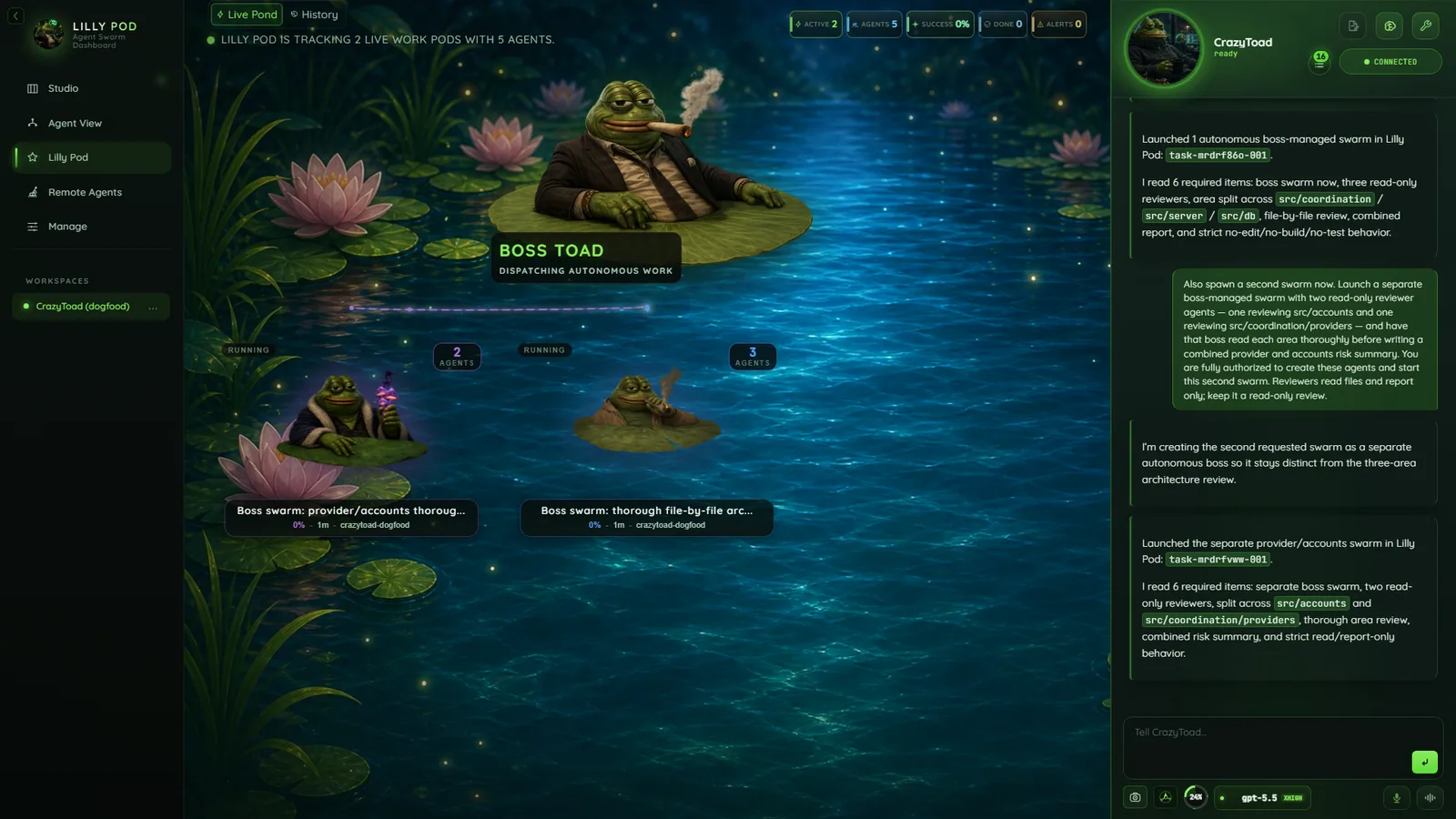
Autonomous swarms with live counts and alerts.
Describe the big goal
- Give Toad the outcome, not each command — state what done looks like.
- The mini-boss handles the plan and the breakdown.
- A genuinely big goal lands as a swarm, not a single agent.
Mini-bosses orchestrate the swarm (per-boss child cap)
- Mini-bosses split the goal and spawn child agents, each taking a slice.
- Every boss runs under a per-boss child cap — scoped, not infinite.
- The brain runs on almost any model; the Gemini and Antigravity CLIs stay agents-only.
Self-correction runs automatically
- When a child stalls or fails, the boss reruns and repairs it on its own.
- Progress continues without you stepping in for every hiccup.
Phase gates keep it on track
- Each phase must clear before the next begins.
- The pod view shows children, progress, and alerts live; badges flag swarms needing a decision.
- Steer at the gate, not at every agent. Repo work reaches GitHub via the
ghCLI.
Get completion visibility (each swarm stays tied to its workspace)
- The boss keeps going until the plan is done, then reports back.
- Outputs land in the right repo context — each swarm stays tied to its workspace.
- Calls to a confined remote agent stay approval-gated.
- Want to watch a slice live? Spawn an Agent View pane.
When to reach for it
When the job is too big to watch and too long to drive by hand.
Multi-phase goalsStages a boss sequences through phase gates.
Large fan-outMany parallel slices across child agents, under the cap.
Overnight runsUnattended work you check on later.
Completion visibilityYou want the result and a report, not the steering.